

Childhood tuberculosis (TB), while impacting nearly a million children across the globe, isn’t as well diagnosed and is likely under or overtreated compared with TB in adulthood. The Shortened Regimen for Drug-Susceptible TB in Children (SMILE-TB) trial, led by the SMART4TB Consortium, and funded by the U.S. government, is focused on addressing this critical population, evaluating a shorter treatment regimen for children with pulmonary and lymph node tuberculosis. When children are diagnosed and treated quickly and effectively, it can have an enormous impact on their future and their caregivers. SMILE-TB is currently enrolling participants in Uganda, Indonesia, and Zambia, where local researchers are seizing this opportunity to improve treatment and care.
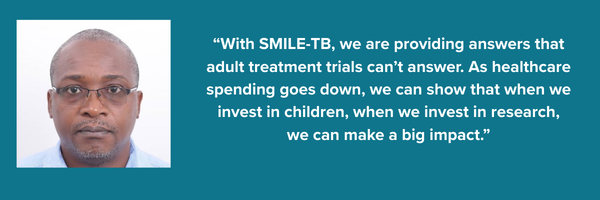
Dr. Chishala Chabala is a pediatrician and lecturer at the University of Zambia and the principal investigator of the SMILE-TB trial in Zambia.
How did you come to the field of TB and specifically, pediatric TB?
I’ve worked on TB for 20 years, starting out as a provincial TB coordinator in Southern Zambia and seeing the impact of TB in clinics, particularly people with HIV and TB. As a pediatrician, it was glaring how neglected TB in children was. We saw so many changes in treatment for adults based on trials, but such little attention was given to children, so that motivated me.
What is the potential for the SMILE-TB trial to impact children living with TB, their caregivers, and families? It’s potentially a game-changer; the standard treatment was six months, then it was reduced to four months based on the results of the SHINE trial (Shorter Treatment for Minimal Tuberculosis in Children) and now, in SMILE-TB, we’re looking at two months, encompassing pulmonary and lymph node TB.
The current treatment requires going to a facility for the duration of the treatment, which is a big cost, both for the family and the health service. Parents sometimes have to take off work for several days and the longer you are taking medication, the more potential for side effects and adverse events. We also know that when a child presents with TB, more often than not there is another person in the house who has TB so caring for the child and adult makes it difficult. With shorter treatment, you know that you are saving costs for the family, and you are reducing side effects for the child.
What is unique about the TB epidemiology in Zambia?
Zambia is a high-burden TB country, we have high rates of HIV infection and high rates of TB in children who are malnourished. This trial gives us an opportunity to look at children with added health complexities, including taking a lot of medication (in the case of HIV and TB) and managing their nutrition. What we learn in Zambia will be applicable to similar settings in sub-Saharan Africa.
Why is research like this important to pursue right now?
Typically, these types of trials are done in adults, and we have to extrapolate from those results what to do with children. With SMILE-TB, we are providing answers that adult treatment trials can’t answer. As healthcare spending goes down, we can show that when we invest in children, when we invest in research, we can make a big impact.
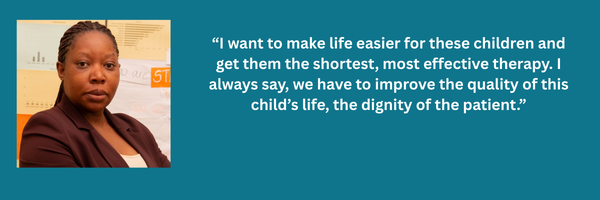
Dr. Bwendo Nduna is the Senior Medical Superintendent Arthur Davison Children’s Hospital and an investigator of the SMILE-TB trial in Ndola, Zambia.
How did you come to the field of TB and specifically, pediatric TB?
I had an interest in neonatology and infectious diseases as a medical student and a strong interest in research because as I was doing my specialization, most of our learning was through evidence-based practices. You start to learn how children are managed throughout the world, and you are learning how to provide the best standard of care. When you look at TB diagnosis in children, it’s difficult to make. Even an experienced clinician will toil around and have difficulty and that worried me. The first battle is that you must convince the parent that the child has TB, and then when you start the treatment, it’s so long.
When I started out, it was common to start a child on first line antibiotic treatment, switch to second line antibiotics when there was a poor response, by the time you get to the third line you start to worry that it’s TB. That would mean six months of “imprisonment” on medication. Parents would then be worried about how long they will be in the hospital, how many injections they will get, and things like that.
When the various healthcare workers I’ve trained to manage pediatric TB see me at the grocery store, they think of TB, and I take it as a sign of how passionate I am about this work.
What is the significance of the SMILE-TB study in Ndola? What is the study’s potential for children living with TB, caregivers, and their families?
I’m so excited, whenever you think of pill burdens, it’s huge. A child who has HIV is already taking so many pills, and then you give them a diagnosis of TB and now they are swallowing even more pills for a long duration. I want to make life easier for these children and get them the shortest, most effective therapy.
I always say, we have to improve the quality of this child’s life, the dignity of the patient. It’s a game changer, and it opens other avenues for research and collaboration. A child being unwell is not a natural thing. You see the catastrophic costs of patients who have TB, and this trial has the potential to lessen all of that. It’s such a welcome thing.